
Type “AI SEO tools” in Google and you will see hundreds of articles claiming that artificial intelligence can optimize your content for keywords, come up with blog post briefs on autopilot, and more. And they are right: AI makes content creation and SEO dramatically faster than before.
Working with AI SEO tools while studying marketing, I have discovered some valuable insights into how AI-powered programs work and where they can be applied. I believe that AI SEO tools are assistants but underperform when it comes to strategic decision-making. They can suggest keyword lists in ten seconds. Not which keywords your audience would actually type in Google at 11 p.m, when they are ready to make a decision.
I am not trying to pit humans against AI; rather, I want to show you my practical experience with AI SEO tools and highlight the border between their capabilities.
Limitations of AI SEO Tools
Before painting a picture of AI’s limitations, let me note what these tools can do. First, AI SEO tools can perform research faster, giving you a superficial understanding of a topic. Second, they can help you brainstorm by suggesting hundreds of keyword variations and content ideas. Third, they can produce drafts of your blog posts, which you can then edit. Finally, they can explain concepts to you if you are a beginner and need an understanding of SEO before diving into actual keyword research.
If you are using AI SEO tools in these four ways, you are doing everything. However, if you use them for decision-making, you are making a common mistake.
Where AI SEO Tools Cannot Help
1. AI SEO Tools Can Miss Nuances in Search Intent
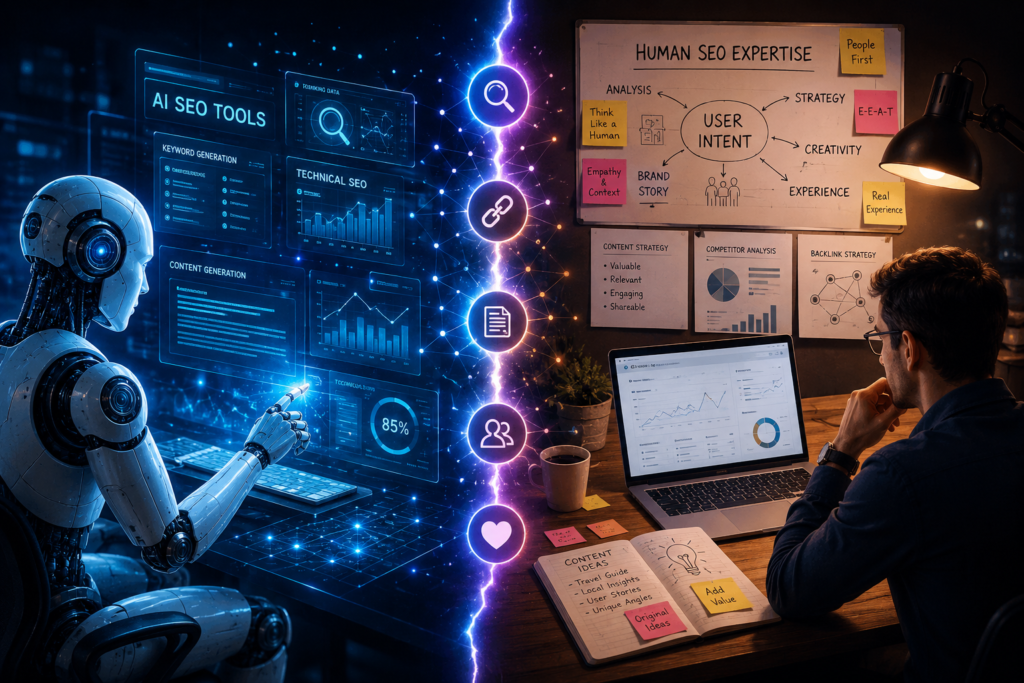
AI tools are often too generic and fail to account for your audience’s traits and behaviors. Most tools focus on trends and overlook specifics relevant only to your niche. I have used ChatGPT to come up with SEO content ideas and keyword suggestions while learning marketing, and the results were rarely satisfying. While they did not fail completely, they always lacked specificity. The keywords and headings suggested by the tools were good for a reader but not for the specific audience I was targeting.
Therefore, I always needed to go over the recommendations and edit them to make them more relevant to my audience. My advice to you is not to use tools when targeting a specific group of people; invest in a tool that understands your audience.
2. AI SEO Tools Do Not Account for Location or Business Objectives
Another common limitation I have noticed is that AI tools are bad at accounting for specifics. They can suggest SEO best practices, but if you want to target a local audience, you need a human SEO specialist. A local audience will have expectations of your business compared to a global audience, and only a human knows the specifics of doing business in a certain region. The same goes for understanding the audience’s demands better than your competitors.
3. AI SEO Tools Are Too Optimistic About Their Suggestions
One of the things about using AI tools is that they rarely admit they are wrong. A keyword recommendation from an AI tool might be misleading. It will be delivered with the same confidence as a successful recommendation. Therefore, when it comes to SEO advice I need to implement, I always double-check the information provided by AI. I think the only trustworthy use of AI in SEO is as a proofreader or an editor. Everything else requires intuition and strategic thinking.
The border between what AI tools can and cannot do in SEO can be seen in this table:
| Task | AI SEO Tools | Human SEO Strategist |
| Speed of research | Fast | Slow |
| Broad keyword brainstorming | Fast | Moderate |
| Understanding search intent | Slow | Fast |
| Local/business context | Slow | Fast |
| Customized strategy | Slow | Fast |
| Performance analysis & trend adaptation | Moderate | Fast |
| Backlink building & relationships | Slow | Fast |
| First-draft speed | Fast | Slow |
| Final decision-making | Slow | Fast |
You see that AI SEO tools beat humans in speed and volume, whereas humans are better at thinking and customization.
A Practical Way to Use AI SEO Tools, Backed by Experience
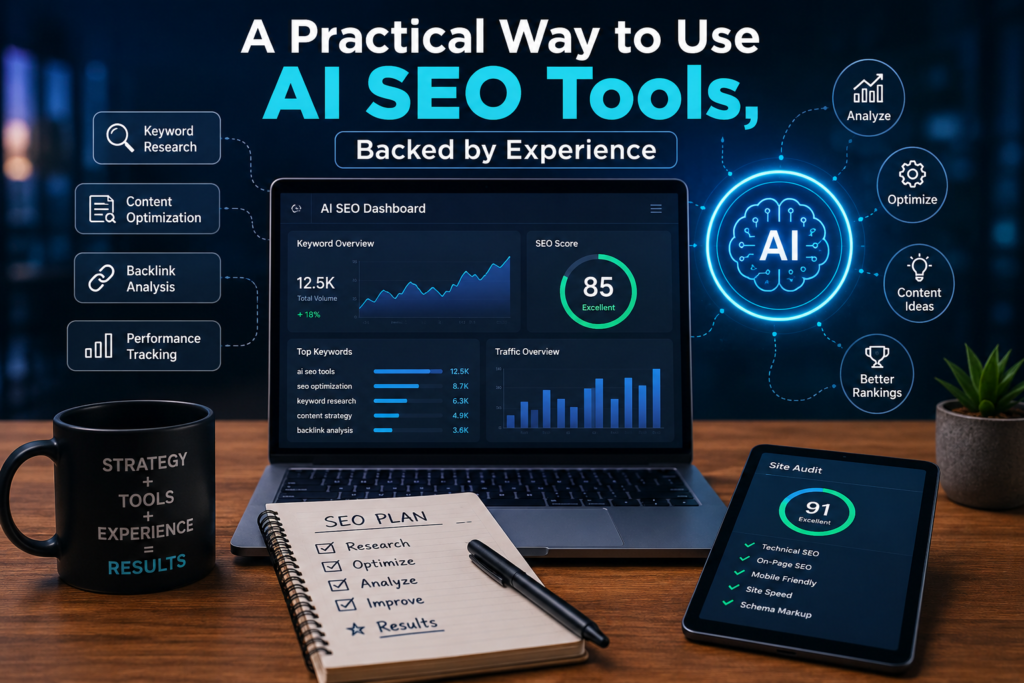
The effective way to use AI SEO tools, in my opinion, is to use them as a first step in content creation and then edit the results manually. Here is how exactly this process can look:
• Use AI SEO tools to come up with a list of keywords and a content brief.
• Make sure the keywords you choose reflect your audience’s search intent and are relevant to your audience (if applicable).
• Edit the suggested headings and content to make them more relevant to your business.
• Fact-check the information provided by AI SEO tools.
• Review the version of the content, making sure that the keywords are relevant and placed strategically.
This approach takes advantage of the speed of AI while allowing you to exercise your thinking skills as an SEO specialist.
A Common Mistake to Avoid
The common mistake I can think of is trusting the suggestions of AI SEO tools without editing them. You could spend hours generating a list of keywords only to realize that none of them are specific to your audience. A trustworthy-looking keyword list can mislead you into believing that the suggestions are good enough when in fact they lack customization and fail to consider your audience’s needs.
Now that we have discussed the effective ways to use AI SEO tools, let me reply to some common questions.
FAQ
Are AI SEO tools worth using? They are definitely worth using. Only for research, brainstorming, and editing. AI SEO tools can speed up the process of creating content and optimizing it for keywords dramatically.
Can AI SEO tools replace an SEO strategist? At the time of writing, I do not believe they can replace an SEO strategist because they are not good at understanding search intent and adapting to your audience.
What is the best way to combine SEO and AI SEO? Use AI SEO tools for research, brainstorming, and first drafting. Then rely on human skills for customization, fact-checking, and final approval.
Conclusion
AI SEO tools are an addition to any marketer’s skill set but cannot replace years of professional experience. They are invaluable when it comes to research, brainstorming, and first drafting but lack thinking and miss vital customization details that human SEO specialists can provide. In some cases, the best option is to use AI SEO tools in combination, with human SEO to get the best results by using the strengths of both.